


Frequently Asked Questions
TABLE OF CONTENTS
- 1. What is Halon?
- 2. Why is Halon the best choice?
- 3. Is Halon still legal?
- 4. How long will the supply of Halon last?
- 5. How safe is Halon?
- 6. Does Halon remove oxygen from the air?
- 7. Is Halotron 1 a type of Halon?
- 8. Where can I get more information about Halon and other clean agents?
- 9. How are Hand Fire Extinguishers Approved?
- a. Federal Regulations for Hand Fire Extinguishers.
- b. Extinguishers Approved Under Industry Standards Organizations.
- c. Minimum Rating.
- 10. Can I use a dry chemical fire extinguisher rather than Halon?
- 11. Do I need an FAA form 8130-3 for this fire extinguisher?
- 12. Do regulations require that a Halon fire extinguisher be removed from a plane at high temperatures?
- 13. Inspection and Maintenance Requirements
- 14. What is the proper way to use a fire extinguisher?
- 15. Why does the gauge of my new extinguisher indicate the need for a recharge?
- 16. What is the shelf life of H3R Aviation fire extinguishers?
- 17. Can H3R Aviation trace the manufacture date of a fire extinguisher?
- 18. Where can I get an H3R Aviation fire extinguisher recharged?
- 19. Are Halotron 1 fire extinguishers allowed in Europe?
- 20. What type of portable fire extinguishers are allowed in the EU?
1. What is Halon?
Halon is a liquefied, compressed gas that stops the spread of fire by chemically disrupting combustion. Halon 1211 does not leave a residue and is rated for class "A" (common combustibles), class "B" (flammable liquids) and "C" (electrical) fires. Halon 1211 is a low-toxicity, chemically stable compound that, is easily recyclable.Halon has been used for fire and explosion protection throughout the 20th century, and remains an integral part of the safety plans in many of today's manufacturing, electronic and aviation companies. Halon protects computer and communication rooms throughout the electronics industry; it has numerous military applications on ships, aircraft and tanks and helps ensure safety on all commercial aircraft.
Because Halon is a CFC, production of new Halon ceased in 1994 as required by the Montreal Protocol. There is no cost effective means of safely and effectively disposing of the Halon. Therefore, recycling and reusing the existing supply intelligently and responsibly to protect lives and property is the wisest solution.
2. Why is Halon the best choice?
Fire needs fuel, oxygen and heat to propagate. The most common extinguishing agents like water, carbon dioxide, dry chemical and foams attack the fire physically to deprive the fire of one or more of these three three elements. Halon differs in the way it puts out the fire. It offers some of water's cooling effect and some of carbon dioxide's smothering action, but its essential extinguishing technique lies in its capacity to chemically react with the fire's components. It actually interrupts the chain reaction of fire.Water is very effective on class A fires (common combustibles like wood and paper). Halon is effective on common combustibles (although not as effective as water), but Halon is also effective on class B (flammable liquids), and it does not conduct electricity back to the extinguisher operator (class C).
Halon is similar to CO2 in that it is suitable for use in cold weather and leaves no residue. Unlike CO2, however, Halon does not displace the air from the area where it is dispensed. Even for the toughest fires, less than an 8% concentration of Halon by volume is required, leaving plenty of air to use in the evacuation process. Also, unlike CO2, there is no danger of "cold shock to avionics or other sensitive electrical equipment.
Dry chemical fire extinguishers are effective on A, B and C class fires. However, they are highly corrosive, and create billowing clouds of choking dust. Dry chemical extinguishers should not be used in an aviation environment.
Foam extinguishers are effective on class A and B fires, and are particularly useful for preventing ignition of flammable liquid spills. However, foams are inferior to Halon in that they do require cleanup and in that they are not for use on electrical fires.
Halon 1211 is a liquefied gas which, when discharged, leaves the nozzle in a stream that is about 85% liquid and 15% gas. This gives the agent a range of 9 to 15 feet and offers significant advantages in fighting fires in large aircraft cabins.
Related FAR Sections and CFR.
a. FAR 21.305 b. FAR 23.561 c. FAR 25.561; 25.851 d. FAR 27.561 e. FAR 29.561; 29.851; 299.853(e) & (f) f. FAR 91.193(c) g. FAR 121.309(c) h. FAR 125.119(b) i. FAR 127.107(c) j. FAR 135.155. k. Title 46 and 49 of the CFR
3. Is Halon still legal?
Because Halon is a CFC, the production of Halon ceased on January 1, 1994, under the Clean Air Act. There is no cost-effective means of safely and effectively disposing of the Halon that has already been produced, therefore recycling and reusing the existing supply intelligently and responsibly to protect lives and property is the best solution.The EPA recognizes that that Halon remains the most effective "clean" extinguishing agent available, despite its ozone depleting potential, and there are no federal or state regulations prohibiting the buying, selling or use of Halon extinguishers. All Halon available now is recycled so it is an environmentally responsible choice.
4. How long will the supply of Halon last?
While the production of Halon ceased on January 1, 1994, under the Clean Air Act, it is still legal to purchase and use recycled Halon and Halon fire extinguishers. In fact, the FAA continues to recommend Halon fire extinguishers for aircraft.According to an industry white paper by Wickman Associates dated March 16, 2002, there will be a bank of approximately 3748 tons in 2030. At H3R Aviation, we are certain that the eventual demise of Halon will come not from insufficient supply, but from the development of an equally effective agent that does not damage the ozone layer and is relatively inexpensive. No such agent is currently available.
5. How safe is Halon?
Halons are low-toxicity, chemically stable compounds that have been used for fire and explosion protection from early in the last century. Halon has proven to be an extremely effective fire suppressant. Halon is clean (i.e., leaves no residue) and is remarkably safe for human exposure. Halon is a highly effective agent for firefighting in closed passenger carrying areas. Due to its effectiveness and relatively low toxicity, the FAA continues to recommend or require Halon extinguishers for use on commercial aircraft.Extensive toxicity evaluations have been compiled by nationally recognized United States medical laboratories and institutions on Halon 1301 (used in fire suppression systems) and Halon 1211 (used in portable fire extinguishers)These evaluations have shown that Halon 1301 is the safest extinguishing agent available, and that Halon 1211 is the second safest.
6. Does Halon remove oxygen from the air?
It is a common misconception that Halon "removes oxygen from the air."According to the Halon Alternative Research Corporation (www.harc.org): "Three things must come together at the same time to start a fire. The first ingredient is fuel (anything that can burn), the second is oxygen and the last is an ignition source. Traditionally, to stop a fire you need to remove one side of the triangle-the ignition, the fuel or the oxygen. Halon adds a fourth dimension to fire fighting-breaking the chain reaction. It stops the fuel, the ignition and the oxygen from working together by chemically reacting with them.
7. Is Halotron 1 a type of Halon?
Halotron 1 is a "clean" fire-extinguishing agent intended to replace Halon 1211. NFPA 2001, "Standard on Clean Agent Fire Extinguishing Systems" defines a "Clean Agent" to be "an electrically non-conducting volatile, or gaseous fire extinguishant that does not leave a residue upon evaporation." Halotron is a safe, effective, environmentally acceptable replacement for Halon 1211. It is discharged as a liquid that rapidly evaporates. Halotron 1 is a proprietary three-component chemical blend based on HCFC-123.8. Where can I get more information about Halon and other clean agents?
www.nafed.org - National Association of Fire Equipment Distributors (NAFED)www.arffwg.org - Aircraft Rescue & Fire Fighting Group (ARFF)
www.fssa.net - Fire Suppression Systems Association (FSSA)
www.harc.org - Halon Alternatives Research Corporation (HARC)
www.nist.gov - National Institute of Standards & Technology (NIST)
www.esd.worldbank.org/mp - Montreal Protocol AC 20-42C, Hand Fire Extinguishers for Use in Aircraft dated 03/07/84
AC20-42D Hand Held Fire Extinguishers For Use in Aircraft
EPA - RULE 40 CFR Part 82 Protection of Stratospheric Ozone: Manufacture of Halon Blends, Intentional Release of Halon, Technician Training and Disposal of Halon and Halon-Containing Equipment.
FINAL RULE SUMMARY EPA BAN ON HALON MARCH 5, 1998 (63FR 11084)
Halon information: Q & A on Halon and Their Substitutes
9. How are Hand Fire Extinguishers Approved?
a. Federal Regulations for Hand Fire Extinguishers. Hand fire extinguishers are required under 14 CFR §§ 23.851, 25.851(a)(1), 29.851 (a)(1), 29.853(e) & (f), 91.513(c), 119.25, 121.309(c), and 135.155. We approve hand fire extinguishers to be used on aircraft under the provisions of 14 CFR § 21.305(d). Accordingly, this AC is provided as one means acceptable to us for the approval of hand fire extinguishers, other than water solution extinguishers approved under TSO-CI9.Note: Although 14 CFR parts 91 and 125 don't require our approval of hand fire extinguishers, we consider the information in this AC acceptable for use by Part 91 and 125 operators.
b. Extinguishers Approved Under Industry Standards Organizations. We approve hand fire extinguishers for use in aircraft when they meet industry standards. Extinguishers approved in this manner should also meet the safe-use guidance provided in this AC. In addition, replacement agents must meet additional requirements specified in paragraph 2 below. We accept hand fire extinguishers approved by:
(I) U.S. - Underwriters Laboratories, Inc. (U.S. - UL) according to U.S. - UL Standard 711, Rating and Fire Testing of Fire Extinguishers, and U.S. - UL construction and performance requirements for specific agent extinguishers with a U.S. - UL Listing mark (See paragraph 3c below.) or equivalent such as:
(2) Factory Mutual Research Corporation (FM) with listing mark, or
(3) The U.S. Coast Guard (USCG) with marking per 46 CFR § 162.028.
c. Minimum Rating. Your hand fire extinguisher should be rated per the requirements of U.S. - UL 711, dated December 17, 2004 or equivalent, as noted in paragraph 1 b above. Hand extinguishers produced in the U.S. or those used on airplanes and/or rotorcraft operated within the U.S. should meet U.S. - UL fire rating standards.
(I) Large Aircraft. The required hand extinguishers should be listed and have a minimum U.S. - UL 5B:C rating or the equivalent. Exception: See chapter 4, paragraph 5 of this AC for minimum extinguisher ratings for use in accessible cargo compartments.
(2) Small Airplanes or Rotorcraft. You may use an extinguisher with a minimum rating of U.S. - UL 2B:C or equivalent on aircraft with maximum compartment volumes of up to 200 ft3.
10. Can I use a dry chemical fire extinguisher rather than Halon?
The best way to answer this question is to cite NFPA Standards and other published documents:NFPA 410 Aircraft Maintenance (Addendum) A-7-3.1
All-purpose (ABC) dry chemical-type extinguishers should not be used in situations where aluminum corrosion is a problem.
NFPA Fire Protection Handbook Chapter-Basics of Fire and Science
Extinguishment with Dry Chemical Agents:
One reason that dry chemical agents other than monoammonium phosphate are popular has to do with corrosion. Any chemical powder can produce some degree of corrosion or other damage, but monoammonium phosphate is acidic and corrodes more readily than other dry chemicals, which are neutral or mildly alkaline. Furthermore, corrosion by other dry chemicals is stopped by moderately dry atmosphere, while phosphoric acid has such a strong affinity for water that an exceedingly dry atmosphere would be needed to stop corrosion.
Air Transport Newsletter, by Ronald Horn, Nov./Dec. 1983, "Class A-B-C Extinguishers Damage Aircraft."
"The A-B-C extinguishers have excellent fire-fighting capability, but the mono-ammonium-phosphate chemical agent melts and flows when it comes into contact with heat. This is how it gets its Class A rating. This chemical is highly corrosive to aluminum, and once it contacts hot aluminum and flows down into the structural cracks and crevices it cannot be washed out as the B-C dry chemical agents can."
"Once an A-B-C extinguisher is used on an airplane, it is necessary to disassemble the aircraft piece by piece and rivet by rivet to accomplish cleanup. Failure to do so will result in destruction of the aircraft by corrosion."
11. Do I need an FAA form 8130-3 for this fire extinguisher?
No, not in North America. A factory-new Halon fire extinguisher does not require an 8130-3 because it is not considered an aircraft part.The FAA does not provide a list of authorized fire extinguishers for aircraft. The FAA does specify the following regulations. According to AC 20-42C, "Hand Fire Extinguishers for Use in Aircraft:"
"The FAA accepts hand fire extinguishers approved by Underwriters Laboratories, Inc."
"For occupied spaces on aircraft, Halon 1211 extinguishers should not be less than 2½ pounds (1.2kg) capacity. These extinguishers should have a minimum 5B:C rating; not less than 8 seconds effective discharge time; not less than a 10 ft. (3 meter) range, and may be equipped with a discharge hose."
12. Do regulations require that a Halon fire extinguisher be removed from a plane at high temperatures?
Following are excerpts from three key documents regarding the use of fire extinguishers on aircraft.In AC20-42C, "Hand Held Fire Extinguishers for use in Aircraft," the FAA recommends "approved" (such as by UL) fire extinguishers for use in aircraft, but mentions nothing about removing a fire extinguisher from an aircraft due to temperature.
NFPA 408, 2-1.4, "Standard for Aircraft Hand Portable Fire Extinguishers," states: "All aircraft hand portable fire extinguishers shall function properly at temperature ranges from -40 degrees F to 120 degrees F."
NFPA 10 "Standard for Portable Fire Extinguishers" does call for aluminum-shelled fire extinguishers to be removed from service and hydrostatically tested if they are exposed to temperatures in excess of 350 degrees F.
13. Inspection and Maintenance Requirements
Halon 1211, Halotron and FM-200 fire extinguishers distributed by H3R Aviation, Inc. should be installed, inspected and maintained in accordance with the owner's manual supplied with the extinguisher and NFPA No. 10, "Portable Fire Extinguishers." The following summarizes portions of those two documents.MONTHLY INSPECTION
Fire extinguisher shall be inspected when initially placed in service and at minimum 30-day intervals or more frequently if circumstances dictate. Persons performing 30-day inspections are not be required to be certified.
Check to see that the extinguisher is undamaged; that the nozzle is unobstructed; that the gauge pressure is in the operable (green) range; that the lockpin and tamper seal is in place, and that the operating instructions are clearly visible. If the inspection reveals a deficiency in any of these conditions, corrective action must be taken.
MAINTENANCE
Annual Maintenance
Extinguishers shall be subjected to maintenance not more than one year apart or when specifically indicated by an inspection. Maintenance is a thorough examination of the extinguisher, covering mechanical parts, extinguishing agent and expelling means. It is intended to give maximum assurance that an extinguisher will operate effectively and safely, and should be done professionally. Most authorities require special tags be attached to the extinguisher to verify this service.
Six-Year Maintenance
Every six years, stored pressure fire extinguishers that require a 12-year hydrostatic test shall be emptied and subjected to applicable maintenance procedures. This should be done professionally, and involves a thorough inspection and the replacement of certain parts. When these maintenance procedures are performed during periodic recharging or hydrostatic testing, the six year requirement shall begin from that date.
Twelve-Year Hydrostatic Test
All H3R Aviation fire extinguishers require a 12 year hydrostatic test performed by certified technicians as per NFPA 10. Simply stated, the Hydrostatic test confirms the integrity of the cylinder, and at the 12 year mark, is performed in conjunction with the 6 year maintenance.
14. What is the proper way to use a fire extinguisher?
The following instructions are of a general nature, intended to familiarize the user with the basic operating techniques of H3R Aviation hand portable extinguishers. All operate by removing the safety pin and squeezing the handles together. Since extinguishers differ, the extinguisher nameplate must be consulted for specific procedures and starting distances.Note: WHENEVER POSSIBLE, PROTECTIVE CLOTHING AND BREATHING EQUIPMENT SHOULD BE USED WHILE FIGHTING A FIRE.
 1. HOLD THE EXTINGUISHER UPRIGHT AND PULL THE RING (SAFETY) PIN breaking the plastic seal.
 2. STAND BACK FROM THE FIRE (the minimum distance stated on the nameplate) and AIM AT THE BASE OF THE FIRE NEAREST YOU.
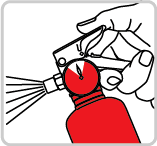 3. Keeping the extinguisher UPRIGHT, SQUEEZE THE HANDLES TOGETHER to discharge and SWEEP FROM SIDE TO SIDE. Move closer as the fire is extinguished but not so close as to scatter the burning material or liquid.
4. When the fire is out, back away while watching for possible re-ignition.
5. Evacuate and ventilate the area immediately after use. The fumes and smoke from any fire may be hazardous and can be deadly.
REMEMBER THIS SIMPLE WORD: PASS
PULL
AIM
SQUEEZE
SWEEP
15. Why does the gauge of my new extinguisher indicate the need for a recharge?
Most if not all extinguishers are filled and pressurized at 68-70 degrees F. Pressure gauges are calibrated to show the normal charged pressure at this temperature. The green area of any pressure gauge is intended to show a charged condition for the extinguisher through the temperature range for which the extinguisher is rated (i.e., -40 degrees through +120 degrees F.) An extinguisher which has been subjected to temperature ranges between -40 degrees and +70 degrees F will register between the left edge of the green pie and the upright charged position. Conversely, extinguishers exposed to abnormally high temperatures will indicate a reading higher than (to the right of) the upright position.If manufacturers were to purposely overpressurize the extinguishers to account for anticipated low temperatures during transit into colder climates, warm weather would bring complaints of overcharged extinguishers.
The pressure/temperature relationship is noticeably greater in Halon (vaporizing liquid) extinguishers than in dry chemical units because Halon itself expands and contracts in relationship to temperature. It is for this reason that the GREEN pie area on Halon gauges is larger than on dry chemical (or water) gauges.
WHEN IN DOUBT: CONDITION THE EXTINGUISHER TO 70 DEGREES F. (21 DEGREES C) FOR SEVERAL HOURS TO OBTAIN AN ACCURATE INDICATION.
16. What is the shelf life of H3R Aviation fire extinguishers?
The inspection and maintenance requirements for fire extinguishers per NFPA 10 call for a 6-year maintenance and a 12-year hydrostatic test - calculated from the month and year of manufacture. As long as the extinguisher undergoes the maintenance and passes the test it can remain in service.H3R Aviation calculates the remaining shelf life of its fire extinguishers by comparing the timing of the 6-year maintenance to the month and year of manufacture per the following formula.
(72 months - Months elapsed from manufacture date) / 72 months = Shelf life remaining
For example, if an extinguisher was manufactured in February of 2022, and it is June 2022, it has a remaining shelf life of 94%.
(72 months - 4 months) / 72 months = 94%
17. Can H3R Aviation trace the manufacture date of a fire extinguisher?
The year of manufacture is noted on the label of every H3R Aviation fire extinguisher. In addition, customers have the option to add a Certificate of Conformance (COC) to their cart when placing an order. The COC outlines production dates and production batch numbers.18. Where can I get an H3R Aviation fire extinguisher recharged?
H3R Aviation does not recharge fire extinguishers. A fire service company or FAA repair station in your area can do this work or recommend someone who can. If the extinguisher is on an aircraft that operates under an FAR that requires a fire extinguisher, the FAA repair station will need to issue an 8130-3.Costs associated with recharging an extinguisher vary. It is a good idea to double-check the price to recharge the extinguisher versus the price of a new unit.
19. Are Halotron 1 fire extinguishers allowed in Europe?
Halotron I units are restricted in Europe because of EU limitations on the use of HCFC based agents since the mid 1980’s. They can be used only if no alternative is available.As EASA and the FAA have accepted Halotron BrX as a replacement agent for Halon 1211 there is a replacement option available on the market that is not HCFC-based.
Here as a link to related information. https://www.unep.org/ozonaction/who-we-are/about-montreal-protocol
20. What type of portable fire extinguishers are allowed in the EU?
Halotron BrX (2-BTP) is the only agent on the EASA-approved list (CM-CS-013 Issue 01) that clears all applicable EU regulatory hurdles:- Halon 1211: banned from use in portable aircraft extinguishers by EU Regulation 2024/590 (end date: December 31, 2025)
- HCFC Blend B (Halotron I): prohibited by EU chemical regulations (EC 1005/2009 / EU 2024/590), which ban HCFCs in fire extinguishers
- HFC-227ea (FM-200) and HFC-236fa (FE-36): restricted off the market by EU F-gas Regulation (EU) 517/2014 due to their extremely high global warming potential
- 2-BTP (Halotron BrX): no HCFC, no high-GWP HFC; currently unrestricted under any EU regulation
Back to top